
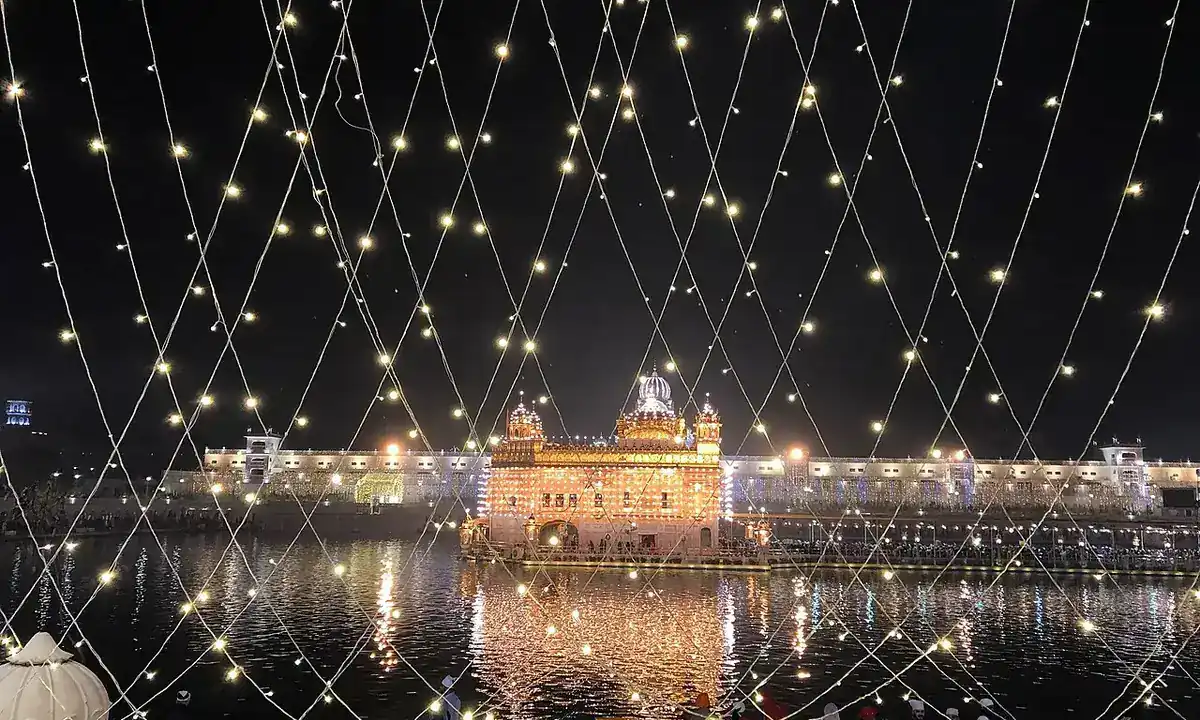
Guru Nanak Gurpurab, also known as Guru Nanak Jayanti or Prakash Purab, celebrates the birth of Guru Nanak Dev Ji, the founder of Sikhism and the first of the ten Sikh Gurus. It is one of the most important days in the Sikh calendar and is marked with continuous scripture readings, processions, kirtan and langar, the free community kitchen open to everyone.
Who was Guru Nanak?
Guru Nanak was born in 1469 in the village of Rai Bhoi di Talwandi, now Nankana Sahib in Pakistan. From a young age he questioned empty ritual and social divisions. Sikh tradition records that, after a spiritual experience at the river Bein near Sultanpur Lodhi, he declared "There is no Hindu, there is no Muslim", meaning that God sees people as equals beyond religious labels.
He spent many years travelling on long journeys known as udasis, reaching places across South Asia and, according to tradition, Tibet, Sri Lanka, Mecca and Baghdad, often accompanied by his companion Bhai Mardana, who played the rabab. In his later years he settled at Kartarpur, where he farmed and built a community around shared work and worship.
His core teachings
Guru Nanak taught that there is one God, expressed in the opening words of the Sikh scripture, Ik Onkar. His teaching is often summarised in three principles:
- Naam japna: remembering and meditating on God's name.
- Kirat karni: earning an honest living through one's own work.
- Vand chhakna: sharing with others, especially those in need.
He rejected discrimination based on caste and gender and taught that ordinary family life could be a spiritual path.
How the date is set
Unlike most Sikh Gurpurabs, which follow the Nanakshahi calendar used by many gurdwaras, Guru Nanak's birth anniversary is celebrated on Kartik Purnima, the full moon of the lunar month of Kartik. That is why the date moves each year and usually falls in November.
Akhand Path and kirtan
Two days before the Gurpurab, gurdwaras begin an Akhand Path, a continuous reading of the entire Guru Granth Sahib by a team of readers that takes about 48 hours and finishes on the morning of the festival. The day begins before dawn with Asa di Var, a morning hymn composed by Guru Nanak, followed by kirtan (devotional singing), katha (talks on Sikh history) and ardas (prayer).
Prabhat Pheris and Nagar Kirtan
In the weeks before the Gurpurab, sangats (congregations) hold Prabhat Pheris, early-morning processions through neighbourhoods singing hymns. On the day before, many cities hold a Nagar Kirtan: the Guru Granth Sahib is carried on a decorated float, led by the Panj Pyare (five beloved ones) holding the Nishan Sahib flag. Gatka performers display traditional Sikh martial arts, and volunteers hand out food and drinks along the route.
Langar: the community kitchen
Langar was established by Guru Nanak as a place where everyone sits together on the floor and eats the same simple vegetarian meal, regardless of religion, caste, wealth or gender. On Gurpurab, gurdwaras serve langar to thousands of people. Typical dishes are dal, sabzi, roti, rice and kheer, and karah prasad, a sweet made of wheat flour, ghee and sugar, is offered to everyone.
Visiting a gurdwara
Everyone is welcome. Cover your head (scarves are usually provided), remove your shoes, wash your hands, and avoid alcohol and tobacco. Sit on the floor in the prayer hall, receive karah prasad with cupped hands, and join the langar. Volunteering, known as seva, in the kitchen or cleaning up is also welcomed.
Kartarpur and celebrations worldwide
Gurdwara Darbar Sahib at Kartarpur in Pakistan, where Guru Nanak spent his final years, has been linked to India by the Kartarpur Corridor since 2019, allowing pilgrims to visit without a visa. Large Gurpurab celebrations take place at the Golden Temple in Amritsar and at Nankana Sahib, and Sikh communities in New Zealand, Australia, Canada, the UK and the US hold Nagar Kirtans and community langars.
Frequently asked questions
When is Guru Nanak Gurpurab 2027?
Sunday, 14 November 2027 in India.
What does Gurpurab mean?
Gurpurab means "the Guru's festival" and refers to anniversaries connected with the lives of the Sikh Gurus.
Why is it also called Prakash Purab?
Prakash means light. The day is seen as the coming of spiritual light into the world through Guru Nanak.
What is an Akhand Path?
A continuous, uninterrupted reading of the Guru Granth Sahib, taking about 48 hours, completed on the morning of the Gurpurab.
Can non-Sikhs attend Gurpurab celebrations?
Yes. Gurdwaras welcome everyone. Cover your head, remove your shoes and join the prayers and langar.
Where was Guru Nanak born?
At Rai Bhoi di Talwandi, now called Nankana Sahib, near Lahore in present-day Pakistan.