
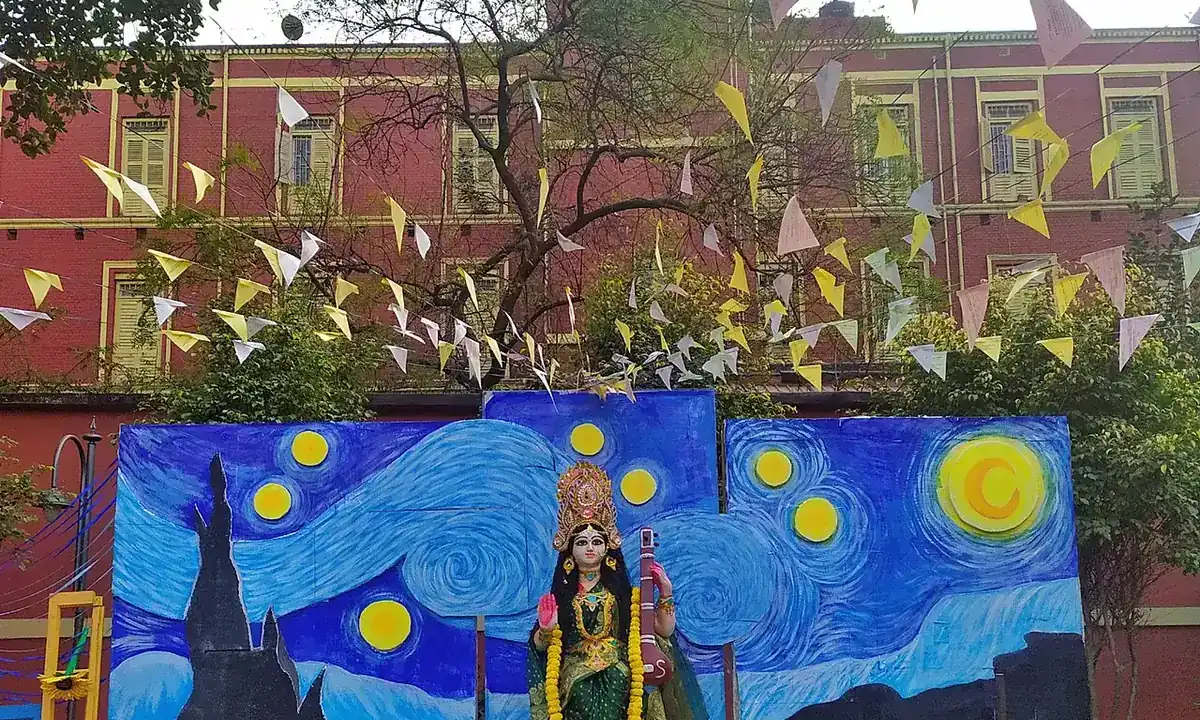
Vasant Panchami welcomes the arrival of spring and honours Saraswati, the Hindu goddess of knowledge, music, art and learning. It is a day for wearing yellow, starting children on their education, placing books and instruments before the goddess and, in some regions, flying kites.
Who is Saraswati?
Saraswati is the goddess of wisdom, speech, learning and the arts. She is usually shown dressed in white, seated on a white lotus or beside a swan, holding a veena (a stringed instrument), a book and a string of prayer beads. Students, musicians, writers and artists pray to her for clarity and inspiration, and many schools and colleges hold Saraswati puja on this day.
How the date is set
Vasant Panchami falls on the fifth day (panchami) of the bright half of the lunar month of Magha, usually in late January or February. The word vasant means spring. The day is traditionally seen as the start of the spring season, and Holi falls about forty days later.
Why yellow?
Yellow is the colour of the day. It recalls the mustard fields that bloom across north India at this time and is associated with energy, knowledge and prosperity. People wear yellow clothes, offer yellow flowers such as marigolds to the goddess, and cook yellow foods coloured with saffron or turmeric.
Beginning to learn
Vasant Panchami is considered an especially good day to begin learning. In a ceremony called Vidyarambham or Akshar Abhyasam, young children are helped to write their first letters, often in rice grains or on a slate, in the presence of a priest or elders. Students place their books, pens and musical instruments before Saraswati and often do not study or play on the day, receiving them back blessed the following day.
Saraswati Puja in Bengal
In West Bengal, Odisha and Assam, Saraswati Puja is one of the biggest festivals for students. Schools, colleges and neighbourhoods set up pandals with images of the goddess. Young people dress up, girls often in yellow saris, and offer anjali (flowers with prayers). A popular custom is not to eat kul (Indian jujube fruit) until it has first been offered to Saraswati, and khichuri with labra (mixed vegetables) is served as bhog.
Kites and spring fairs
In Punjab and parts of north India, Vasant Panchami is celebrated as Basant with kite flying, yellow turbans and dupattas, and fairs. Kite flying from rooftops is a well-known part of the day in many towns. Gurdwaras also hold Basant kirtan, and the poet Amir Khusrau is linked with a long tradition of Basant celebrations at the Nizamuddin dargah in Delhi.
Festive food
Yellow dishes are favourites: kesari bhaat or meethe chawal (sweet saffron rice), kesar halwa, boondi laddoos, rajbhog, khichdi and yellow pulao. In Bihar and eastern India, malpua and kheer are also popular.
Other meanings of the day
In some traditions Vasant Panchami is also associated with Kamadeva, the god of love, and with the start of preparations for Holi, when a log or heap of wood for the Holika bonfire is placed in public squares. Some communities treat it as an auspicious day for weddings, housewarmings and new ventures.
Frequently asked questions
When is Vasant Panchami 2027?
Thursday, 11 February 2027 is the date listed on this website; confirm locally.
Why do people wear yellow on Vasant Panchami?
Yellow represents the mustard flowers of spring, knowledge and prosperity, and is considered Saraswati's favourite colour.
Why do students worship their books?
Saraswati is the goddess of learning, so students place books and instruments before her to seek blessings for their studies.
What is Vidyarambham?
A ceremony in which young children write their first letters, marking the start of formal learning.
Is Vasant Panchami the same as Saraswati Puja?
Yes. In eastern India the festival is mainly known as Saraswati Puja, while in north India it is also celebrated as Basant.
How long after Vasant Panchami is Holi?
Holi usually falls about forty days later, on the full moon of Phalguna.