
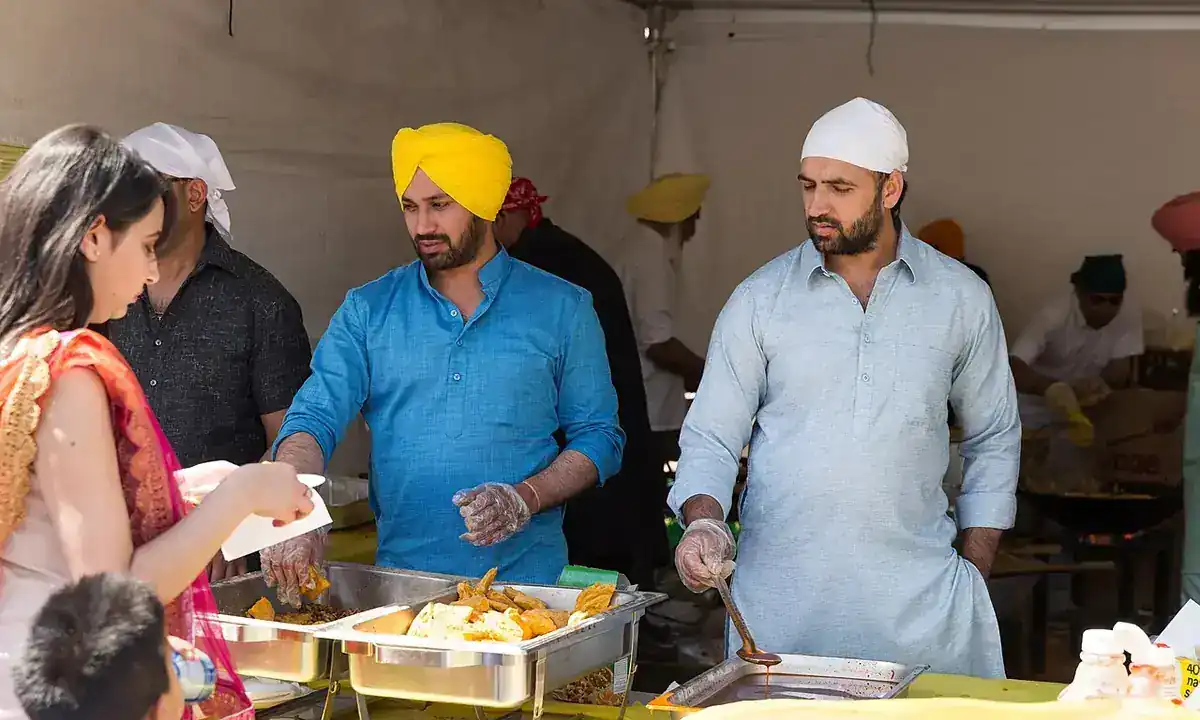
Vaisakhi, also spelled Baisakhi, is both a spring harvest festival in Punjab and one of the most important days in the Sikh calendar. It marks the founding of the Khalsa by Guru Gobind Singh in 1699 and is celebrated with gurdwara services, Nagar Kirtan processions, bhangra and fairs. The same day is a solar new year in several other parts of India.
A harvest festival
In Punjab and Haryana, Vaisakhi falls as the rabi wheat crop ripens. Farmers give thanks for the harvest and prepare to cut the golden fields. Villages hold melas (fairs) with food stalls, wrestling, music and dancing. Bhangra, the energetic men's dance, and Gidda, the women's dance with clapping and folk verses called boliyan, are central to the festivities.
The birth of the Khalsa in 1699
On Vaisakhi in 1699, the tenth Sikh Guru, Guru Gobind Singh, gathered Sikhs at Anandpur Sahib. According to Sikh tradition, he asked who was willing to give their head for their faith. Five men stepped forward one after another. They became the Panj Pyare, the Five Beloved Ones, and were initiated with amrit, sweetened water stirred with a double-edged sword.
The Guru then asked the Panj Pyare to initiate him, showing that the Guru and the disciple were equal. This created the Khalsa, a community of initiated Sikhs committed to faith, equality and the defence of justice. Men were given the name Singh (lion) and women Kaur (princess).
The five Ks
Initiated Sikhs keep five articles of faith, known as the five Ks: kesh (uncut hair, usually covered by a turban), kara (a steel bracelet), kanga (a small wooden comb), kachera (a cotton undergarment) and kirpan (a small sword symbolising the duty to protect the weak). Many Sikhs take amrit at Vaisakhi.
How Sikhs celebrate
Gurdwaras hold special services with kirtan and readings from the Guru Granth Sahib, often following an Akhand Path. The Nishan Sahib, the Sikh flag outside every gurdwara, is taken down, its pole washed and a new cover put on. Many cities hold a Nagar Kirtan, a procession led by the Panj Pyare, with the Guru Granth Sahib carried on a decorated float, gatka martial arts displays and free food served along the route.
Remembering Jallianwala Bagh
Vaisakhi is also remembered for a tragedy. On 13 April 1919, British troops under General Reginald Dyer opened fire on a peaceful crowd gathered at Jallianwala Bagh in Amritsar, killing hundreds of people. The massacre became a turning point in India's independence movement, and many people visit the memorial or pause to remember the victims on Vaisakhi.
A new year across India
Around the same date, the sun enters the sign of Aries (Mesha Sankranti) in the Indian solar calendar, and several regions celebrate their new year: Pohela Boishakh in Bengal, Rongali or Bohag Bihu in Assam, Puthandu in Tamil Nadu, Vishu in Kerala, Pana Sankranti in Odisha and Jur Sital in Mithila. Each has its own foods and customs, but all welcome a new agricultural year.
Food for Vaisakhi
Festive meals often include kadhi chawal, chole bhature, sarson da saag with makki di roti, pinni, kheer and meethe chawal (sweet saffron rice). Gurdwaras serve langar to everyone, and many families share sweets with neighbours.
Vaisakhi around the world
Vaisakhi parades are among the biggest Sikh gatherings outside India. Surrey and Vancouver in Canada, Southall and Birmingham in the UK, Yuba City in the US, and Auckland, Melbourne and Sydney host Nagar Kirtans and festivals that draw large crowds of all backgrounds.
Frequently asked questions
When is Vaisakhi 2027?
Wednesday, 14 April 2027 is the date listed here.
Why is Vaisakhi important to Sikhs?
It marks the founding of the Khalsa by Guru Gobind Singh at Anandpur Sahib in 1699.
Who were the Panj Pyare?
The five Sikhs who volunteered to give their lives for their faith in 1699 and were the first to be initiated into the Khalsa.
Is Vaisakhi the same as Baisakhi?
Yes. They are two spellings of the same festival name.
Why is Vaisakhi usually on 13 or 14 April?
It follows the solar calendar, marking the sun's entry into Aries, so the date is much more stable than lunar festivals.
What is a Nagar Kirtan?
A Sikh procession through the streets, led by the Panj Pyare, with hymn singing and the Guru Granth Sahib carried on a decorated float.