
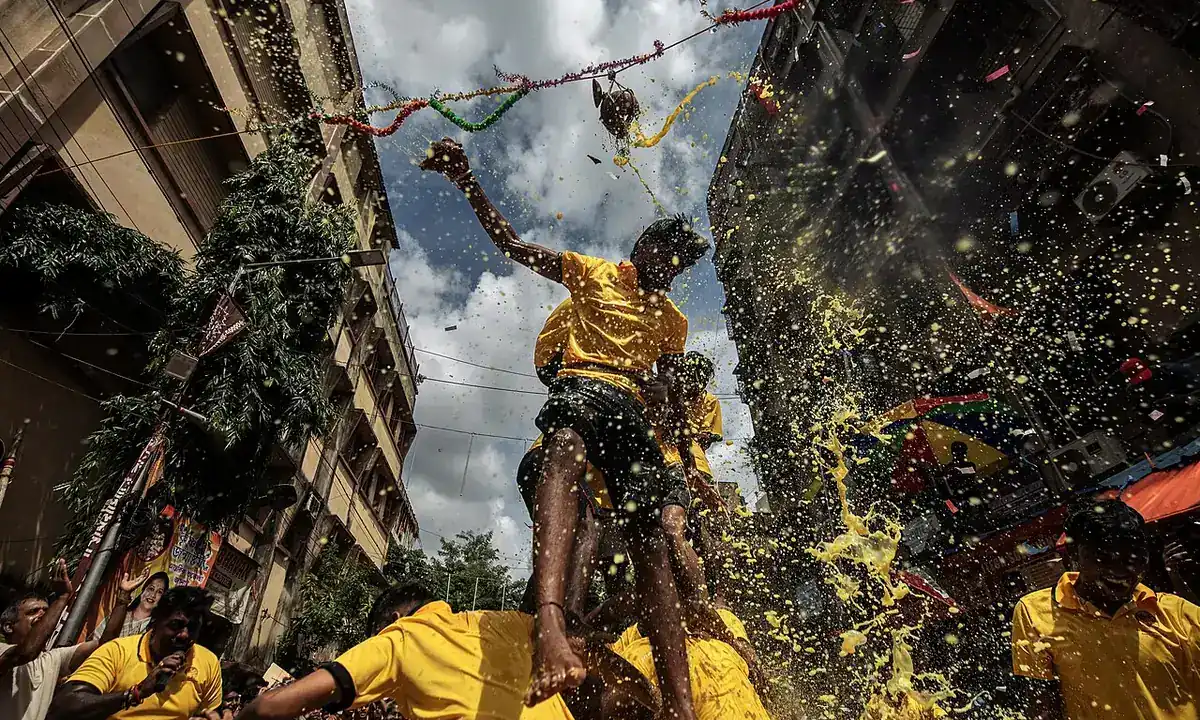
Janmashtami, also called Krishna Janmashtami or Gokulashtami, celebrates the birth of Lord Krishna. Devotees fast, sing bhajans, decorate cradles for baby Krishna and keep vigil until midnight, the hour of his birth. In Maharashtra the next day brings Dahi Handi, when teams form human pyramids to break a pot of curd.
The story of Krishna's birth
Krishna is revered as the eighth avatar of Vishnu. According to the Bhagavata Purana, he was born at midnight in a prison cell in Mathura to Devaki and Vasudeva, who had been imprisoned by Devaki's brother, the tyrant king Kamsa. A prophecy had warned Kamsa that Devaki's eighth son would kill him.
On the night of the birth, the story says the guards fell asleep and the prison doors opened. Vasudeva carried the newborn across the flooded Yamuna river to Gokul, where Krishna was raised by Nanda and Yashoda. Stories of his childhood there, stealing butter, playing the flute and protecting the cowherds, are at the heart of the festival.
How the date is set
Janmashtami falls on the eighth day (ashtami) of the dark half of the lunar month, which is Bhadrapada in the northern purnimanta calendar and Shravana in the amanta calendar used in much of the south and west. Calendars also consider the Rohini nakshatra, Krishna's birth star. Because of this, two dates are often published: one followed by Smarta households and one by Vaishnava groups such as ISKCON. Both are correct for the communities that use them.
Fasting and the midnight puja
Many devotees keep a fast through the day. Some take no food or water (nirjala); others eat phalahar, which includes fruit, milk, nuts and dishes made from buckwheat or water-chestnut flour, without grains. The fast is broken after the midnight celebration.
At midnight a small image of baby Krishna, known as Laddu Gopal or Bal Gopal, is bathed in panchamrit (milk, curd, ghee, honey and sugar), dressed in new clothes and placed in a decorated cradle. Families rock the cradle, ring bells, blow a conch and sing "Nand ke anand bhayo, jai Kanhaiya Lal ki".
Food offered to Krishna
Krishna is remembered as Makhan Chor, the butter thief, so white butter with sugar (makhan-mishri) is a favourite offering. Others include panjiri made from roasted coriander or wheat flour with ghee and dry fruit, dhaniya panjiri, peda, kheer and panchamrit. Some temples prepare chhappan bhog, an offering of 56 dishes.
Dahi Handi
In Maharashtra and Goa, the day after Janmashtami is Dahi Handi or Gopalkala. An earthen pot filled with curd or buttermilk is hung high above the street, and teams called Govinda pathaks climb on each other's shoulders to break it, recreating Krishna and his friends reaching for butter. Crowds cheer and spray water on the climbers. Safety rules now limit the height of pyramids and the age of participants in many areas.
Mathura, Vrindavan and beyond
Mathura, Krishna's birthplace, and nearby Vrindavan hold some of the largest celebrations, with temple decorations, jhankis (tableaux of scenes from Krishna's life) and Raas Leela dance-dramas. Dwarka in Gujarat, Udupi in Karnataka and Puri in Odisha have their own traditions. In Manipur, Krishna devotion is expressed through classical Ras Lila dance.
The Bhagavad Gita connection
Many devotees read or recite the Bhagavad Gita on Janmashtami. In the Gita, part of the Mahabharata, Krishna counsels the warrior Arjuna about duty, action without attachment to results, and devotion. Its verses are widely read for guidance far beyond the festival.
Celebrating outside India
Temples and ISKCON centres in New Zealand, Australia, the UK, Canada and the US hold kirtan, plays and midnight aarti, usually with a large public feast. Children often dress as Krishna or Radha. If you are celebrating at home, a decorated cradle, makhan-mishri and a few bhajans at midnight local time capture the spirit of the day.
Frequently asked questions
When is Janmashtami 2027?
Wednesday, 25 August 2027 in India.
Why are there sometimes two Janmashtami dates?
Smarta and Vaishnava traditions use different rules for the ashtami tithi and Rohini nakshatra, so their dates can differ by a day. Follow the date used by your temple or family.
Why is Krishna worshipped at midnight?
Tradition holds that Krishna was born at midnight, so the main puja and the breaking of the fast happen then.
What can I eat during the Janmashtami fast?
Those who keep a phalahar fast eat fruit, milk, curd, nuts, makhana, and dishes made from buckwheat, water-chestnut flour or sabudana, usually with rock salt and without grains, onion or garlic.
What is Dahi Handi?
A Maharashtrian tradition on the day after Janmashtami in which teams form human pyramids to break a pot of curd hung high above the street.
What is Laddu Gopal?
A form of baby Krishna, often a small brass or metal idol, that families bathe, dress and place in a cradle on Janmashtami.